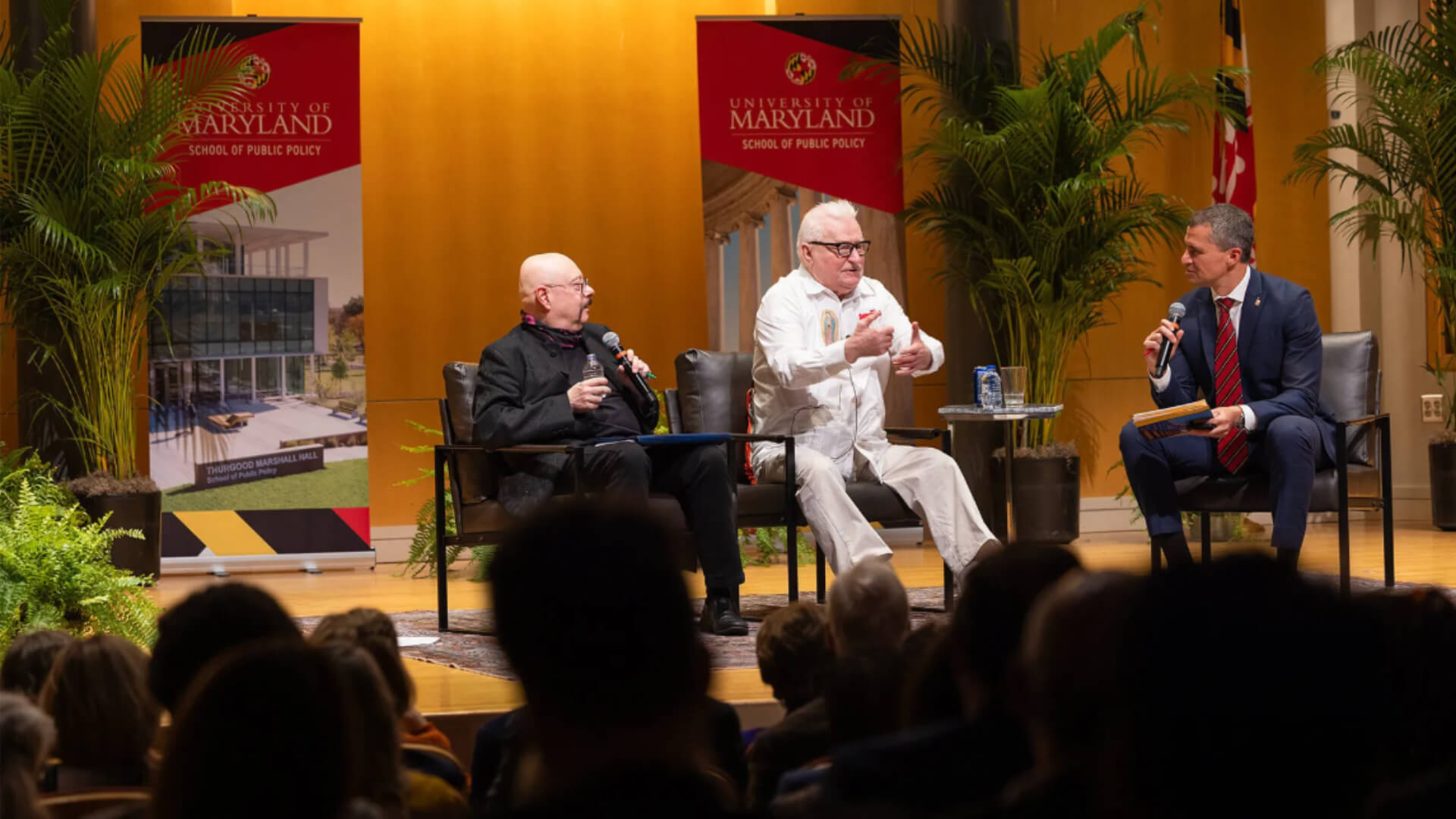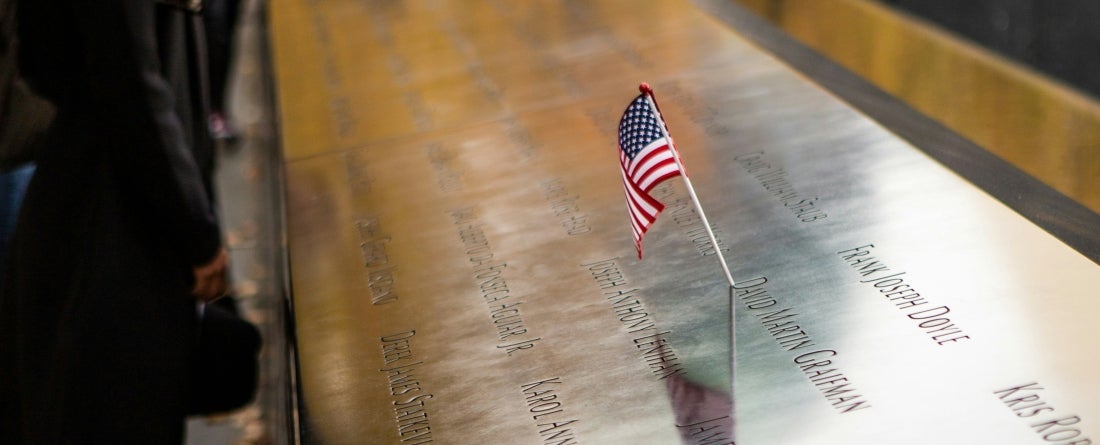
How should Americans assess the decisions that shaped U.S. foreign policy for a generation in the aftermath of the devastating terrorist attacks of September 11, 2001? At an October 7 event, former military officers, intelligence professionals and policy practitioners reflected on how fear and uncertainty influenced America’s response in weeks, months and years that followed. Co-hosted by the student-led International Policy Council and the Global Policy Institute, the panel considered the enduring consequences of those decisions and the lessons learned they offer for future policymakers.
For moderator Alec Worsnop, SPP associate professor and director of the Military Perspectives Speaker Series, the event was an opportunity to connect the personal experiences of those who lived and worked through 9/11 with its lasting effects U.S. policy and security. Christian Smith, a Marine Corps veteran and SPP master’s student who helped organize the discussion, emphasized the importance of bringing those experiences to a new generation. Most students on campus were not yet born on September 11, he observed, but “we are going to inherit that legacy.”
Joining Worsnop and Smith were featured speakers Colin Jackson, co-chair of the Afghanistan War Commission; Ann White, former intelligence official and UMD lecturer and senior research associate; and Jaron Wharton, an infantry officer who deployed multiple times to Iraq and Afghanistan.
Several panelists underscored the importance of understanding the emotional and political climate in which decisions were made. Jackson recalled that amid the shock, fear and anger following the attacks, passion prevailed over reason. In this context, many of the panelists cautioned against judging policymakers through the benefit of hindsight.
The attacks fundamentally changed America’s risk calculus and willingness to use military force. Wharton described how policymakers’ perceptions of risk shifted from responding to immediate threats toward preventing potential future ones. “9/11 didn’t just change whom we were willing to fight; it changed the debate over when we should fight,” he said.
The consequences extended well beyond military operations. White described how barriers between foreign and domestic intelligence agencies hampered the government’s ability to anticipate the attacks. Subsequent reforms improved information sharing but also raised enduring questions about privacy, civil liberties and government oversight. She further cautioned that the pursuit of near-zero risk from terrorism became a perverse incentive to overinvest in counterterrorism at the expense of other priorities.
Reflecting on the flawed intelligence assessments used to justify the Iraq War, White emphasized the importance of safeguarding analytical independence from political priorities. “The point of intelligence is to inform policy,” she said, explaining that intelligence professionals must communicate uncertainty and provide decision-makers with evidence-based assessments rather than preferred conclusions.
Smith, a former student of White’s, enthusiastically endorsed her intelligence course. “I don’t care if you don’t want to enter the intelligence community, you need to take it,” he told the audience.
Panelists examined the human and strategic costs of two decades of conflict. Wharton observed that the United States mobilized its national security institutions without asking American society to shoulder comparable sacrifices. As a result, an increasingly small share of the population–the armed services and their families–was asked to bear the burdens of prolonged warfare.
Smith reflected on this disconnect through his experience conducting military funerals at Arlington National Cemetery. “It really put into perspective the human cost of 20 years of forever war,” he said. He also highlighted the rise of Islamophobia and divisive rhetoric following the attacks, along with an erosion of international goodwill towards the United States.
For Jackson, the wars in Afghanistan and Iraq exposed the limits of American military power when confronting insurgencies. He described how the U.S. military reluctantly adapted to prolonged irregular warfare, often without a clear end state. Nevertheless, Jackson cautioned against concluding that future interventions should always be avoided. Instead, he urged aspiring policymakers to learn from the costly experiences of the past so they could respond more effectively to emerging threats in the future.
The discussion concluded with advice for future leaders navigating difficult decisions under uncertainty. Panelists cited the importance of intellectual curiosity, empathy and humility. They added to this a willingness to seek out diverse perspectives and challenge assumptions. White underscored the importance of courage to deliver unwelcome assessments. “The ability to speak truth in a respectful and helpful way is a foundational principle of adding value to policy-making decisions,” she said.